
Topping up your savings account each month might seem like a sensible way to build a financial safety net for unexpected costs and pay for short-term expenses, such as a holiday or new car.
However, you may be surprised to learn that your cash savings could trigger a tax bill. If so, you’re not alone. Research by Lloyds reveals that 24% of adults in the UK mistakenly believe that any money they hold in a savings account is tax-free.
While you may be able to earn some tax-free savings interest, your returns will be taxed once they exceed certain thresholds.
Moreover, frozen tax thresholds mean more people are losing a portion of their savings to HMRC for the first time or facing a higher tax charge. Research by the Paragon Banking Group shows that the number of people paying £5,000 or more in Income Tax on their savings interest almost tripled between 2022/23 and 2025/26.
With the Income Tax rate for savings set to rise by 2 percentage points from 6 April 2027, now is the time to take control of your wealth and protect as much of your savings from tax as possible.
Read on to learn how tax on savings interest works and find out what you can do to mitigate this potential liability.
You’ll pay tax on savings interest once your returns exceed certain thresholds
Let’s start with the good news.
Depending on your total income, some of your savings interest may be free from Income Tax. There are two key allowances to be aware of.
The starting rate for savings
The starting rate for savings allows you to earn up to £5,000 in savings interest at a 0% tax rate.
However, for every £1 you earn above your Personal Allowance, your starting rate will be reduced by the same amount. The Personal Allowance is the total amount of income you can earn before any tax is due, and it stands at £12,570 in the 2026/27 tax year for most people.
As such, if you earn more than £17,570 in the 2026/27 tax year, you won’t benefit from the starting rate for savings.
Your Personal Savings Allowance
You won’t pay tax on savings interest that falls within your Personal Savings Allowance (PSA).
The allowance you’re entitled to depends on how much you earn, as shown in the table below.
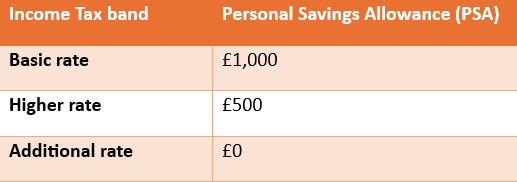
It’s important to note that any savings interest you receive is included in your total taxable income. This means that returns on your savings could push you into a higher band, potentially reducing your PSA.
If you exceed the PSA, you’ll pay Income Tax at your marginal rate. For example, a higher-rate taxpayer will pay 40%, and an additional-rate taxpayer will pay 45%.
How to save smart and reduce your tax bill
If you want to keep your savings as tax-efficient as possible, here are four strategies to consider.
1. Make full use of the annual ISA allowance
Money held in a Cash ISA earns interest in the same way it would in a regular savings account, but there’s no tax to pay on the returns you earn.
In the 2026/27 tax year, you can contribute up to £20,000 tax-efficiently to a Cash ISA or spread across multiple ISA accounts.
As such, using your full annual allowance is a simple yet effective way to maximise your tax-free savings.
However, from April 2027, the annual Cash ISA limit will fall to £12,000 for under-65s. While this reduces how much you can save tax-efficiently, your total ISA allowance will still be £20,000. This means you could invest the remaining £8,000 of your allowance in a Stocks and Shares ISA and benefit from growth free from Dividend Tax and Capital Gains Tax.
2. Increase your pension contributions
Pensions are one of the most tax-efficient ways to save for retirement. Not only do you receive tax relief on contributions, but the money inside your pension grows free from Capital Gains Tax and Income Tax, helping your pot to grow faster.
So, if you’ve exceeded the threshold for paying Income Tax on savings (or are close to doing so), it might be worth moving some of your money into your pension.
You can contribute up to £60,000 (your Annual Allowance) or 100% of your earnings in a single tax year, whichever is lower, without facing an additional tax charge. Your Annual Allowance may be lower if your income exceeds certain thresholds or you have already flexibly accessed your pension.
Unlike cash savings, which you can generally access in the short to medium term, the money held in your pensions is locked away until you’re 55 (rising to 57 in 2028). As such, it’s important to work out how much you can afford to contribute without leaving yourself short until these funds become available.
3. Buy Premium Bonds
Premium Bonds are a government-backed savings account where, instead of earning interest, your money is entered into a monthly cash prize draw, and any winnings are tax-free. You can invest between £25 and £50,000, or up to £100,000 as a couple.
Of course, there’s no guarantee of winning, so you won’t receive regular returns.
However, the prizes can be significant – up to £1 million – and the more Premium Bonds you hold, the more chances you have to win.
You can also withdraw your funds at any time, making this a flexible way to save.
4. Transfer savings to your spouse or partner
If you’re close to exceeding your PSA and your spouse or partner only has a small savings pot, you could transfer some of your money to them so you both stay under the threshold for paying tax.
If you’ve both used your tax-free allowances and your partner or spouse pays a lower rate of Income Tax, moving some of your savings into their account could reduce your total household tax bill.
Get in touch
If you’d like help reviewing your savings and investments to make sure they’re as tax-efficient as possible, we can help.
Please get in touch by email helpme@aspirellp.co.uk or call 0117 9303510 to find out more about what we can do.
Please note
This article is for general information only and does not constitute advice. The information is aimed at individuals only.
All information is correct at the time of writing and is subject to change in the future.
Please do not act based on anything you might read in this article. All contents are based on our understanding of HMRC legislation, which is subject to change.
A pension is a long-term investment not normally accessible until 55 (57 from April 2028). The fund value may fluctuate and can go down, which would have an impact on the level of pension benefits available. Past performance is not a reliable indicator of future performance.
The tax implications of pension withdrawals will be based on your individual circumstances. Thresholds, percentage rates, and tax legislation may change in subsequent Finance Acts.
The value of your investments (and any income from them) can go down as well as up and you may not get back the full amount you invested. Past performance is not a reliable indicator of future performance.
Investments should be considered over the longer term and should fit in with your overall attitude to risk and financial circumstances.
 Production
of clients believe that working with us has helped or will help them achieve their financial goals
of clients who answered definitively said they would recommend us to their friends, family or colleagues
of clients said they were satisfied with our communications during times of market volatility.